Spring Has Sprung, but Not in #Denver!

April 16, 2013 Denver Snow Storm

April 16, 2013 Denver Snow Storm

Now that the weather is starting to warm up it is time to think about the exterior of your house; even if you are not moving this year.

  • Power raking the lawn and fertilizing it are a great start.
  • Check your trees and shrubbery for damage and growth; prune as needed.
  • Clean the gutters and repair any damage caused by snow and ice.
  • Check the roof for damage.
  • Inspect the siding, windows and door frames…do they need caulking or paint?
  • Check for snow or water damage around the bottom of the walls. We all shovel our sidewalks, but who clears the snow away from the house itself?

Walk around your property and develop your own list looking for damage or wear. Watch for movement of sidewalks, driveways or deck columns etc. Has the local wildlife taken up residence on or in your home?

Owning a well maintained home requires a huge responsibility.  One step at a time, however, will keep your home in great shape and ready for summer.

Posted in Buying or Selling Real Estate, Centennial, Cherry Hills Village, Colorado, Denver, Denver Housing, Denver Residential Real Estate, Greenwood Village | Tagged , , , , , , , | Leave a comment

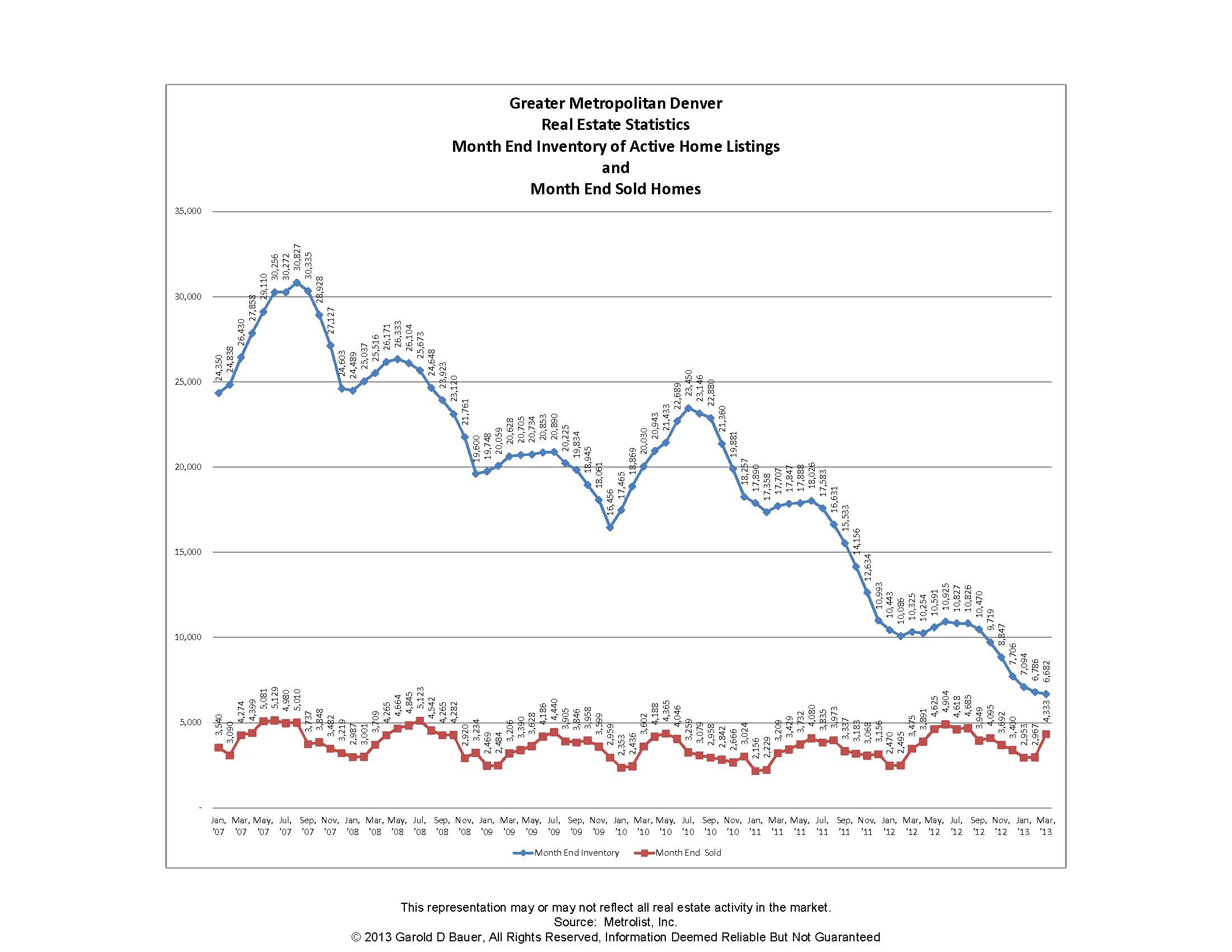
Record Low Inventory in the Denver Market! or Where Is That “Shadow Inventory” When You Need It?

Low Inventory Creates Multiple Offers

Low Inventory Creates Multiple Offers

Critical to any real estate organization is inventory.  As you can see from the attached image (click to expand), is the realization that Denver’s inventory is as low as it gets.  Follow along as our CEO describes the inventory conundrum.

We need your listing!

Good Morning Everyone,

Please look at this chart (attached), the active listing inventory for attached and detached properties dropped -1.53% (-104) on a month over month basis and dropped -35.28% (-3,643) on a year over year basis. In August 2007, there were 30,827 active properties, which is down -78.32% (-24,145) compared to March 2013 (“Peak to Trough”).

At the same time, sales increased for attached and detached properties up +46.04% (1,366) on a month over month basis and up +24.69% (858) on a year over year basis.

I hope you will find this information helpful…enjoy your day.

Peter Niederman | CEO

Kentwood Real Estate

Posted in Buying or Selling Real Estate, Centennial, Cherry Hills Village, Denver, Denver Housing, Denver Residential Real Estate, Greenwood Village | Tagged , , , , , , , | 1 Comment

You Have No Excuse To Not Be A Buyer, Now…

FOR IMMEDIATE RELEASE

Help For Homebuyers: Metro Cities Announce 2013 Homebuyer Assistance Program
4% Down Payment and Closing Cost Grants Available for Qualified Borrowers in Denver and Littleton

DENVER, CO ­— Tuesday, March 19, 2013 — Buoyed by successes from past homeowner programs and with an eye on the future, the City and County of Denver and the Metro Mayors Caucus today launched the Metro Mortgage Assistance Plus Program, a new funding initiative to encourage home ownership.

“There is no better way to help rebuild our local economy and expand the strength and vitality of our neighborhoods than to open the doors of home ownership to moderate and low-income buyers,” said Denver Mayor Michael B. Hancock.

The program reduces the usual barriers to home ownership by providing a 4% grant for down payment and closing cost assistance—money the borrower does not repay—and can offer a competitive interest rate on 30-year mortgages.

The program can currently be used to purchase any property in Denver or Littleton. Additional Metro Mayors Caucus jurisdictions are expected to join the program throughout the year.

Unlike past mortgage assistance programs, there is not a requirement that the buyers be first-time owners, and no time limit on when the individual or family last owned a home. There is also no maximum purchase price.

Interested buyers are encouraged to work with one of the 12 pre-approved lenders who are participating in the program. Along with completing free homebuyer counseling, each buyer needs to meet standard loan guidelines (a FICO of at least 640 and a debt-to-income ratio of 45) and income limits (not more than $91,100 for households of two or fewer people, and not more than $103,000 for three or more).

“It’s the down payment and closing cost help that we believe will really make the difference for these individuals and families,” said Paul Washington, executive director of the Denver Office of Economic Development. “This is just the right program for people who have worked so hard to reach the dream of home ownership, and are so close to making it happen. With our help, we can boost these dreams right over the top.”

The participating lenders include the following:

Air Academy Federal Credit Union, 720-489-0712, 303-757-0300, 303-674-8733
Bank of Commerce Mortgage
Citywide Home Loans
Cornerstone Home Lending, 970-797-3717
Ent Federal Credit Union, 800-525-9623
Peoples Mortgage
Real Estate Mortgage Network (REMN)
Rocky Mountain Mortgage Specialists, Inc.
Summit Mortgage Corporation, 303-779-0591, 720-200-9480
The Mortgage Network, 303-990-2992
Universal Lending Corporation
WR Starkey Mortgage

Buyers are encouraged to contact these lenders directly and indicate their interest in the Metro Mortgage Assistance Plus program.

Single-family homes, condominiums, townhomes and manufactured homes qualify for the program, with the requirement that the owner occupy the home as a primary residence. Mortgage refinancing does not qualify.

The renewable fund will be available on a first-come, first-served basis through December 31, 2014, or while funds remain. For more information on the Metro Mortgage Assistance Plus Program, visitwww.denvergov.org/housing.

Posted in Denver Housing, Denver Real Estate, Denver Renters, Denver Residential Real Estate, Mortgage, Uncategorized | Tagged | 2 Comments

Tom Cryer of Kentwood Real Estate Appointed to Metro Vision Planning Advisory Committee

March 18, 2013

FOR IMMEDIATE RELEASE

(For more information contact Douglas E. Lierle at lierlepr@comcast.net)

Tom Cryer of Kentwood Real Estate Appointed to

Metro Vision Planning Advisory Committee

Leading Real Estate Professional will Assist Denver Regional Council of

Governments with its Metro Vision 2040 Planning Process


Tom Cryer, SCRP

Tom Cryer, SCRP

DENVER – Tom Cryer, a leading real estate professional with The Kentwood Company in the Denver Tech Center, has been appointed to the Metro Vision Planning Advisory Committee (MVPAC) of the Denver Regional Council of Governments (DRCOG), a nonprofit association of local governments dedicated to making the nine-county Denver region a great place to live, work and play.

The MVPAC is the primary policy committee of the DRCOG.  It provides recommendations to the regional council board of directors for action on Metro Vision issues, plans and implements strategies, and works on transportation projects and water quality issues.  Metro Vision is the region’s long-term growth and development plan.

Throughout its 58-year history, DRCOG has worked to promote a regional perspective toward the most pressing issues facing the metropolitan area and to address those issues through cooperative local government action.  The organization is funded by membership dues and federal and state grants.

“I am pleased to be joining the Metro Vision committee and look forward to contributing to this forward looking group of civic-minded residents,” said Cryer.  “We will work on ways to involve citizens in the planning process and develop outreach efforts and establish stakeholder engagement opportunities.  It’s great to see local officials working together to address the region’s challenges for today and tomorrow.”

Cryer is a Senior Certified Relocation Professional and has garnered numerous awards from the Employee Relocation Council over the years.  He has served as President of the Relocation Appraisers and Consultants organization and has served the diverse real estate needs of clients since 1976.  Cryer earned his bachelor’s degree from the University of Denver.

For more information on real estate services from Tom Cryer, phone 303-638-3202 or contact Tom via email at Tom@DenverRealEstate.com.

Kentwood Real Estate is dedicated to its legacy of being “Colorado’s Premier Real Estate Company” through the highest producing, most knowledgeable, caring and experienced sales team in the country, offering the highest quality customer service experience.  Kentwood Real Estate is an innovator known for unparalleled marketing strategies and superior Internet technology that places its clients in the best possible position.

Kentwood Real Estate is comprised of The Kentwood Company in the Denver Tech Center, The Kentwood Company at Cherry Creek, and Kentwood City Properties in downtown Denver.  For more information, visit Kentwood Real Estate online at www.DenverRealEstate.com.

# # #


Posted in Uncategorized | Tagged , , , , , , , , , | 1 Comment

Denver Resale & New Home Inventory Has Never Been Lower

Super Joe Hubert

Super Joe Hubert

Super Joe Hubert of Land Title Guarantee Company posts his monthly report. It clearly confirms my year end 2012 analysis of the Denver Market. Buyers are frustrated. Sellers are fending off multiple offers. Brokers offer an empathetic ear to find new solutions.

Meanwhile interest rates are still lower than last year t this time. It’s simply put a great time to be in Denver’s residential market. If you are a buyer, locking in long term rates today will pay dividends in the future. If you can be a seller, your prices are better than they’ve been in five years.

So follow along with Joe’s analysis, and focus on the facts! Just the facts….

Hi Tom,

There’s three seconds left on the clock and the score is tied. Everything is on the line with this last shot. The player dribbles the ball to mid-court and throws the ball as the clock reads zero…. Swoosh! The crowd goes wild!

March Madness is right around the corner and just as the college basketball players will be feeling pressure on the court this month, we know many of you are feeling pressure out there in the real estate market with low inventory and high demand. Land Title wants to help you succeed in your bracket of buyers and sellers.

Contact me for ideas on how to stand out in today’s market and tools to help you succeed.

Wishing you many “wins” in March!

Sincerely,
Joe

February – 2013 Real Estate Market Update

Entire MLS (All Areas)

Residential Highlights:

  • 19.5% increase in the number of closed sales year-over-year
  • 18.5% increase in the number of closed sales year to date
  • 23.6% decrease in average days on market (81)
  • 31.4% decrease in active listings
  • 11.7% increase in average price – sold

Condo Highlights:

  • 16.8% increase in number of closed sales year-over-year
  • 22.1% increase in number of closed sales year to date
  • 27.7% decrease in average days on market (73)
  • 37.9% decrease in number of active listings
  • 8.8% increase in average price – sold

Click here for Full report of entire MLS

Posted in Denver Housing, Denver Real Estate, Denver Renters, Denver Residential Real Estate, Uncategorized | Tagged , , , , , , , , | Leave a comment

The Sky Is Not Falling – 6 Home Deduction Traps and How to Avoid Them

Urgent Notice

Contrary to Henny Penny, The Sky Is Not Falling!

Get an “A” on your Schedule A Form: Dodge these tax deduction pitfalls to save time, money, and an IRS investigation.

Trap #1: Line 6 – real estate taxes

Your monthly mortgage payment often includes money for a tax escrow, from which the lender pays your local real estate taxes.

The money you send the bank may be more than what the bank pays for your taxes, says Julian Block, a tax attorney and author of Julian Block’s Home Seller’s Guide to Tax Savings. That will lead you to putting the wrong number on Schedule A.

Example:

  • Your monthly payment to the lender: $2,000 for mortgage + $500 escrow for taxes
  • Your annual property tax bill: $5,500

Now do the math:

  • Your bank received $6,000 for real estate taxes, but only paid $5,500. It may keep the extra $500 to apply to the next tax bill or refund it to you at some point, but meanwhile, you’re making a mistake if you enter $6,000 on Schedule A.
  • Instead, take the number from Form 1098—which your bank sends you each year—that shows the actual taxes paid.

Trap #2: Line 6 – tax calculations for recent buyers and sellers

If you bought or sold a home in the middle of 2012, figuring out what to put on line 6 of your Schedule A Form is tricky.

Don’t simply enter the number from your property tax bill on line 6 as you would if you owned the house the whole year. If you bought or sold a house in midyear, you should instead use the property tax amount listed on your HUD-1 closing statement, says Phil Marti, a retired IRS official.

Here’s why: Generally, depending on the local tax cycle, either the seller gives the buyer money to pay the taxes when they come due or, if the seller has already paid taxes, the buyer reimburses the seller at closing. Those taxes are deductible that year, but won’t be reflected on your property tax bill.

Trap #3: Line 10 – properly deducting points

You can deduct points paid on a refinance, but not all at once, says David Sands, a CPA with Buchbinder Tunick & Co LLP. Rather, you deduct them over the life of your loan. So if you paid $1,000 in points for a 10-year refinance, you’re entitled to deduct only $100 per year on your Schedule A Form.

Trap #4: Line 10 – HELOC limits

If you took out a home equity line of credit (HELOC), you can generally deduct the interest on it only up to $100,000 of debt each year, says Matthew Lender, a CPA with EisnerLubin LLP.

For example, if you have a HELOC for $200,000, the bank will send you Form 1098 for interest paid on $200,000. But you can deduct only the interest paid on $100,000. If you just pull the number off Form 1098, you’ll deduct more than you’re entitled to.

Trap #5: line 13 – Private mortgage insurance

You can deduct PMI on your Schedule A Form, as long as you started paying the insurance after Dec. 31, 2006. Congress renewed the PMI deduction for 2012 and 2013 for people making less than $110,000.

Since you’re thinking about it, this is also a good time to review your PMI: You might be able to cancel your PMI altogether because you’ve had a change in loan-to-value status.

Trap #6: line 20 – casualty and theft losses

You can deduct part or all of losses caused by theft, vandalism, fire, or similar causes, as well as corrosive drywall, but the process isn’t always obvious or simple:

  • Only deduct losses that are greater than 10% of your adjusted gross income (line 38 of Form 1040).
  • Fill out Form 4684, which involves complex calculations for the cost basis and fair market value.  This form gives you the number you need for line 20.

Bottom line on line 20: If you’ve got extensive losses, it’s best to consult a tax pro. “I wouldn’t do it myself, and I’ve been dealing with taxes for 40 years,” says former IRS official Marti.

This article provides general information about tax laws and consequences, but shouldn’t be relied upon as tax or legal advice applicable to particular transactions or circumstances. Consult a tax professional for such advice.

Let’s thank Barbara Eisner Bayer for this valuable information!

Published: December 21, 2012

Posted in Buying or Selling Real Estate, Centennial, Cherry Hills Village, Colorado, Denver, Denver Housing, Denver Residential Real Estate, Greenwood Village | Tagged , , , , , , , | 1 Comment

It’s Your Castle, but Here’s What You Can and Can’t Deduct When You Work From Home

A Man's Home Is His Castle...

A Man’s Home Is His Castle…

Working from home can offer many advantages including tax deductions. Just take care what you try to write off for your home office on your return.

Passing the IRS litmus test

To meet IRS guidelines, your home office must be your principal place of business, or the place you see clients in the normal course of business. Parts of your home you use to store products or equipment for your business also count. That doesn’t mean that all your work has to be done from home. If you’re an outside salesperson, you probably spend most of your work time elsewhere. But if you do you billing and return customer calls primarily from your home, your home office should qualify.

You can also qualify for the deduction if your employer requires you to work from home, as long as you don’t charge your employer rent. One big catch is that you must maintain the at-home office for your employer’s convenience, not your own, such as to complete reports at night or on weekends. Self-employed workers use IRS Form 8829 to calculate the deduction, which they list on Schedule C.

Measuring your home office

The amount you can deduct for your home office depends on the percentage of your home used for business. Your work space doesn’t need to be a separate room—a table in a corner qualifies. But it has to be an area that’s used solely for business. The tax break also covers separate structures on your property, like a detached garage you’ve converted to an office. Unlike an office inside your home, a separate structure doesn’t have to be your main place of business to qualify for a deduction. That’s because the IRS believes your family is less likely to use a separate structure as a part-time play area or den, says Mark Luscombe, principal analyst for tax and consulting at CCH.

To calculate what percentage of your house the home office occupies, divide your home office’s square footage by the total square footage of your home. If your home is 3,000 square feet and your office is 150 square feet, for example, you’d use 5% to calculate your deductions. Not sure how big your house is? Check the documents you received when you bought your home—there’s probably a detailed rendering—or measure the outside of your home and multiply length times width.

What can you deduct?

Once you’ve figured out what percentage of your home you use for business, you can apply that percentage to different home expenses. These include:

  • Mortgage interest
  • Real estate taxes
  • Utilities (heating, cooling, lights)

Just take each expense and multiply it by your home office percentage (the 5% mentioned above). That’s the amount you can deduct as a business expense. So if you spend $150 a month on electricity, you can deduct $7.50 as a business expense. That adds up to a $90 deduction per tax year.

Save bills or cancelled checks to prove what you spent in case of an IRS audit. Take an hour a week to file them away. Also, only repairs can be expensed; improvements must be depreciated.

Don’t forget depreciation

Depreciation is based on the idea that everything—even something like a home—wears out eventually. To figure home office depreciation, start by calculating the tax basis of your home: generally the purchase price plus the cost of improvements, minus the value of the land it sits on. Next, multiply the tax basis by the percentage of your home used for work. This gives you the tax basis for your home office.

Usually, depreciation deductions for a home office are figured over a 39-year period. There are caveats. For a crash course, read IRS Publication 946 or talk to a tax pro.

Keep in mind that depreciation deductions on your home office increase the amount of profit on a home sale that is subject to taxes. There’s an exclusion of $250,000 of profit if you’re a single filer, $500,000 for joint filers. Consult with a qualified tax professional on how depreciation deductions affect your tax liability when you sell.

This article provides general information about tax laws and consequences, but shouldn’t be relied upon as tax or legal advice applicable to particular transactions or circumstances. Consult a tax professional for such advice.

Let’s thank Donna Fuscaldo for this valuable information!

Published: December 21, 2012

Posted in Buying or Selling Real Estate, Centennial, Cherry Hills Village, Denver, Denver Housing, Denver Residential Real Estate, Greenwood Village | Tagged , , , , , , , | Leave a comment

The 1-2-3 How to Deduct Your Mortgage Interest & Equity Loan Costs

20120724-145905.jpgDeducting mortgage interest, as well as interest on home equity loans and HELOCs, can save money on taxes.

 Know your loan limits

A good place to check out what you can deduct before you borrow is the chart on page 3 of IRS Publication 936. It’ll walk you through the requirements you must meet to deduct all of your home loan interest. It’s an hour well spent.

The first hurdle you’ll run into is the total amount of your loan or loans. In general, individuals and couples filing jointly can deduct the interest on up to $1 million ($500,000 if you’re married and filing separately) in combined home loans, as long as the money was used for acquisition costs, that is the cost to buy, build, or substantially improve a home, explains Scott O’Sullivan, a certified public accountant with Margolin, Winer & Evens in Garden City, N.Y. Any interest paid on loan amounts above the $1 million threshold isn’t deductible.

The same $1 million limit applies whether you have one home or two. Buying a vacation home doesn’t double your loan limits. And two homes is the max; you can’t deduct a mortgage for a third home. If you have a mortgage you took out before Oct. 13, 1987, you have fewer restrictions on claiming a full deduction. The calculations for “grandfathered debt” can get complex, so get help from a tax professional or refer to IRS Publication 936.

Whatever you do, don’t forget that you can also deduct the points and fees associated with a first or second mortgage when you initially buy your home, says Jeff Rattiner, a CPA with JR Financial Group in Centennial, Colo. If you refinance the same house, you have to deduct those costs over the entire term of the loan. If you refinance again, you can deduct all the costs from the earlier refi in the year you take out the new loan.

Spend loan proceeds wisely

The other limitation on how much you can borrow and still get your deduction comes into play when you take out a home equity loan or HELOC that you don’t use to buy, build, or improve your home. In that case, you can deduct the interest you pay only on the first $100,000 ($50,000 if married filing separately). This loan limit also applies in a so-called cash-out refi, in which you refinance and take out part of the equity you’ve built up as cash, says John R. Lieberman, a CPA with Perelson Weiner in New York City.

That means if you decide to take out a $115,000 home equity loan to buy that Porsche, you can deduct the interest on the first $100,000 but not on the $15,000 that exceeds the limit. Use the same $115,000 to add a new bedroom, however, and the full amount is allowable under the $1 million cap. Keep in mind, though, that the $115,000 gets added into the pot of whatever else you owe on your other home loans. In many cases, points and loan origination costs for HELOCs are deductible.

Consider this simplified scenario: You borrow $250,000 against your home at 8% interest. That means you’ll pay $20,000 in interest the first year. Spend the $250,000 on home improvements, and all of the interest is deductible. Spend $150,000 on improvements and $100,000 on your kids’ college tuition, and all the interest is still deductible.

But spend $100,000 on improvements and $150,000 on tuition, and the improvement outlays are deductible, though $50,000 of the tuition expense isn’t. That’ll cost you $4,000 in interest deductions. Preserve the $4,000 deduction by coming up with the extra money for tuition from another source, perhaps a low-interest student loan or by borrowing from a retirement plan. For someone in a 25% bracket, a $4,000 deduction lowers taxes by $1,000, plus applicable state income taxes.

Beware the dreaded AMT

Even if you’ve followed all the loan limit rules, you can still get stuck paying tax on mortgage interest. How come? It’s all thanks to the Alternative Minimum Tax. Congress created the AMT, which limits or eliminates many deductions, as a way to keep the wealthy from dodging their fair share of taxes.

Calculating the AMT can be complex, but if you make more than $75,000 and have several kids or other deductions, you might well be subject to it. Problem is, if you fall into the AMT group, you may not be able to deduct interest on a home equity loan, even if the loan falls within the $1 million/$100,000 limit. If you’re subject to the AMT and borrow money against the value of your home, you’ll have to use it to buy, build, or improve your place, or you may not have a chance to deduct the interest, says Rattiner, the Colorado CPA.

This article provides general information about tax laws and consequences, but shouldn’t be relied upon as tax or legal advice applicable to particular transactions or circumstances. Consult a tax professional for such advice.

Let’s thank Richard Koreto for this valuable information!

Published: December 21, 2012

Posted in Buying or Selling Real Estate, Centennial, Cherry Hills Village, Colorado, Denver, Denver Housing, Denver Residential Real Estate, Greenwood Village | Tagged , , , , , , , | Leave a comment

9 Easy Mistakes Home Owners Make on Their Taxes

Retirement Planning

Retirement Planning

Don’t rouse the IRS or pay more taxes than necessary — know the score on each home tax deduction and credit.

 Sin #1: Deducting the wrong year for property taxes

You take a tax deduction for property taxes in the year you (or the holder of your escrow account) actually paid them. Some taxing authorities work a year behind — that is, you’re not billed for 2013 property taxes until 2014. But that’s irrelevant to the feds.

Enter on your federal forms whatever amount you actually paid in 2013, no matter what the date is on your tax bill. Dave Hampton, CPA, tax manager at the Cincinnati accounting firm of Burke & Schindler, has seen home owners confuse payments for different years and claim the incorrect amount.

Sin #2: Confusing escrow amount for actual taxes paid

If your lender escrows funds to pay your property taxes, don’t just deduct the amount escrowed, says Bob Meighan, CPA and vice president at TurboTax in San Diego. The regular amount you pay into your escrow account each month to cover property taxes is probably a little more or a little less than your property tax bill. Your lender will adjust the amount every year or so to realign the two.

For example, your tax bill might be $1,200, but your lender may have collected $1,100 or $1,300 in escrow over the year. Deduct only $1,200. Your lender will send you an official statement listing the actual taxes paid. Use that. Don’t just add up 12 months of escrow property tax payments.

Sin #3: Deducting points paid to refinance

Deduct points you paid your lender to secure your mortgage in full for the year you bought your home. However, when you refinance, says Meighan, you must deduct points over the life of your new loan. If you paid $2,000 in points to refinance into a 15-year mortgage, your tax deduction is $133 per year.

Sin #4: Misjudging the home office tax deduction

This deduction may not be as good as it seems. It’s complicated, often doesn’t amount to much of a deduction, has to be recaptured if you turn a profit when you sell your home, and can pique the IRS’s interest in your return. Hampton’s advice: Claim it only if it’s worth those drawbacks. If so, here’s what to  know about what you can write off.

Sin #5: Failing to repay the first-time home buyer tax credit

If you used the original home buyer tax credit in 2008, you must repay 1/15th of the credit over 15 years. If you used the tax credit in 2009, 2010, or 2011 and then sold your house or stopped using it as your primary residence, within 36 months of the purchase date, you also have to pay back the credit.

The IRS has a tool you can use to help figure out what you owe.

Sin #6: Failing to track home-related expenses

If the IRS comes a-knockin’, don’t be scrambling to compile your records. Many people forget to track home office and home maintenance and repair expenses, says Meighan. File away documents as you go. For example, save each manufacturer’s certification statement for energy tax credits and lender or government statements to confirm property taxes paid.

Sin #7: Forgetting to keep track of capital gains

If you sold your main home last year, don’t forget to pay capital gains taxes on any profit. You can exclude $250,000 (or $500,000 if you’re a married couple) of any profits from taxes. So if you bought a home for $100,000 and sold it for $400,000, your capital gains are $300,000. If you’re single, you owe taxes on $50,000 of gains. However, there are minimum time limits for holding property to take advantage of the exclusions, and other details. Consult IRS Publication 523.

Sin #8: Filing incorrectly for energy tax credits

If you made any eligible improvements in 2012 — or will in 2013 — such as installing energy-efficient windows and doors, you may be able to take a 10% tax credit (up to $500). But keep in mind, it’s a lifetime credit. If you claimed the credit in any recent years, you’re done. Fill out Form 5695.

Part II of the form, which covers systems eligible for a larger tax credit through 2016, such as geothermal heat pumps, can be incredibly complex and involves crosschecking with half a dozen other IRS forms. Read the instructions carefully.

Sin #9: Claiming too much for the mortgage interest tax deduction

You can deduct mortgage interest only up to $1 million of mortgage debt, says Meighan. If you have $1.2 million in mortgage debt, for example, deduct only the mortgage interest attributable to the first $1 million.

This article was original published in Jan. 2011.

This article provides general information about tax laws and consequences, but shouldn’t be relied upon as tax or legal advice applicable to particular transactions or circumstances. Consult a tax professional for such advice.

Let’s thank G. M. Filisko for this informative information!

Published: December 31, 2012

Posted in Buying or Selling Real Estate, Centennial, Cherry Hills Village, Colorado, Denver, Denver Housing, Denver Residential Real Estate, Greenwood Village | Tagged , , , , , , , | Leave a comment

A Reverse Mortgage Can Be A Lifesaver!

These numbers substantiate my theory: Reverse Mortgages are not for everyone, but for the people who need them, a Reverse Mortgage is a LIFE SAVER!

77 million Number of baby boomers entering the senior sector

50% Federal Reserve estimate of boomers with NO retirement savings

$49,800 Average savings of those who have saved (other than home equity)

80% Seniors who have substantial equity in their home

81% Seniors planning to remain in their homes for as long as possible

43% Seniors unable to afford to remain in their homes without using a Reverse Mortgage

$80,000 Average national annual cost of basic nursing home care

4x Nursing home care compared to senior who remains in their home

595,000 Current number of active HECM Reverse Mortgages

$19 billion Annual cost of nursing home care for those 43% of RM borrowers who needed a reverse mortgage to remain in their home had they not done a reverse mortgage

The moral of this story is “get your ducks in a row” while the waters are calm. Don’t wait for a problem, anticipate the problem!

20130206-174053.jpg

Posted in Denver, Denver Housing, Denver Real Estate, Denver Residential Real Estate | Tagged , | Leave a comment