
|
|||||||||||||||||||||||||||||||||


 <!– –>


Trinity Property Inspection | . | Highlands Ranch | CO | 80129
|


|
|||||||||||||||||||||||||||||||||
Trinity Property Inspection | . | Highlands Ranch | CO | 80129
|

Super Joe Hubert
Once again Joe Hubert has offered up Land Title’s market data year over year. This October data is reflective of some long term strength. Shrinking supply with low interest rates and few new homes coming along, could a shortage be far behind? Joe reports, you decide…
Hi Tom,
Listed below are Real Estate Market Update links for October, 2011 and a PDF attachment of likely MLS areas for South Metro Denver sales offices.
As with previous months, October, 2011 sales information had a few mixed indicators. October, 2011 combined MLS Residential Statistics had the following changes compared to October of 2010.
The Number of Closed Sales increased (up 8.9%%, to 2,482)
Average Days on Market remained consistent at 102 days
Number of Active Listings decreased significantly (down 30% to 11,504)
Absorption Rate declined 34% to 5.1 months
Average Sold Price decreased 6.1% (from $287,048 to $269,503)
For more details on the combined MLS Residential Statistics, select the first link below titled “Total MLS” or feel free to contact me if you have any questions.
Joe
Please note: The information included is for October. These links will automatically update to the November information within the first week of December. The October links will then be inactive. If you wish to keep the current information on file, you can save the PDF files to your computer for future use.
Total MLS
All Metrolist Areas as one download
View the MLS Map
Aurora North (AUN)
Aurora South (AUS)
Brighton, Fort Lupton (BFL)
Broomfield (BRM)
Douglas County West (DCW)
Douglas Elbert Parker (DEP)
Douglas Highlands Ranch Lone Tree (DHL)
Denver Northeast (DNE)
Denver Northwest (DNW)
Denver Southeast (DSE)
Denver Southwest (DSW)
Downtown Denver (DTD)
East Suburban North (ESN)
East Suburban South (ESS)
Jefferson County Central (JFC)
Jefferson County North (JFN)
Jefferson County South (JFS)
Jefferson County West (JFW)
Jefferson County Northcentral (JNC)
Jefferson County Southcentral (JSC)
Lafayette (LAF)
Mountain Clear Creek (MCC)
Mountain Conifer Pine (MCP)
Mountain Evergreen North (MEN)
Mountain Evergreen South (MES)
Mountain Gilpin County (MGC)
Mountain Jefferson County (MJC)
Mountain Jefferson North (MJN)
Mountain Jefferson South (MJS)
Mountain Park County (MPC)
Mountain Park East (MPE)
North Northeast Suburban (NNE)
North Northwest Suburban (NNW)
North Suburban Central (NSC)
North Suburban East (NSE)
North Suburban West (NSW)
South Suburban Central (SSC)
South Suburban East (SSE)
Superior (SUP)

Highline Canal
This is great news for all of the Highline Canal pedestrians and riders. This has been a very inconvenient crossing for many years. Now a cure seems in sight! This seems like money well spent.
Construction begins Dec. 1 on Iliff Avenue at the High Line Canal
Motorists can expect traffic delays during High Line Canal at Iliff Underpass construction
Denver, CO — On Dec. 1, construction will begin at the intersection of Iliff Avenue and High Line Canal Trail in Denver as Arapahoe County starts work on a trail underpass. From Dec. 1-4, severe congestion will occur when Iliff Avenue is reduced to one lane in each direction, 24 hours per day, to allow for the removal of the median. Currently, when trail-users on the High Line Canal Trail reach Iliff Avenue, they must cross at-grade, meaning they must compete with the traffic to cross the roadway. This has created safety concerns for both trail users and vehicular traffic.
To address the issue, Arapahoe County has partnered with the Colorado Department of Transportation, Denver Water and the City and County of Denver to install a trail underpass that will allow users of the High Line Canal Trail to cross safely under Iliff Avenue in unincorporated Arapahoe County. As part of the project, sidewalks will be extended over the High Line Canal on the south side of Iliff.
“Once complete, the new trail underpass will allow pedestrians and cyclists to travel under Iliff Avenue, instead of fighting traffic when they attempt to cross the major roadway,” said Arapahoe County Commissioner Nancy Jackson. “Traffic flow will be smoother, as motorists will no longer need to stop to accommodate pedestrians and bicyclists crossing Iliff Avenue.”
Lawrence Construction has been selected to complete the project, which is scheduled to take six months. Because traffic delays and congestion on Iliff Avenue will be significant during this time and will include temporary lane or road closures or restrictions during key construction phases, alternate routes or travel schedules are advised.
The County encourages residents to consider carpooling, using public transit, varying travel schedules or using alternate routes during this period. Project personnel are working diligently to minimize the impacts on traffic, but congestion is anticipated to be substantial. The County would like to thank residents in advance for their patience and understanding during this time.
Additional information on the project can be found on Arapahoe County’s web site at http://bit.ly/IliffProject. Sign up to receive weekly e-mail updates by sending your name, address and e-mail address to Iliff.Highline@gmail.com, call 303-419-3301 with any questions and/or follow Arapahoe County on Twitter for project announcements.
* * *

Seven Wednesday evenings this fall, I attended the Transit Alliance Citizens’ Academy. I’m proud to report, I made it!
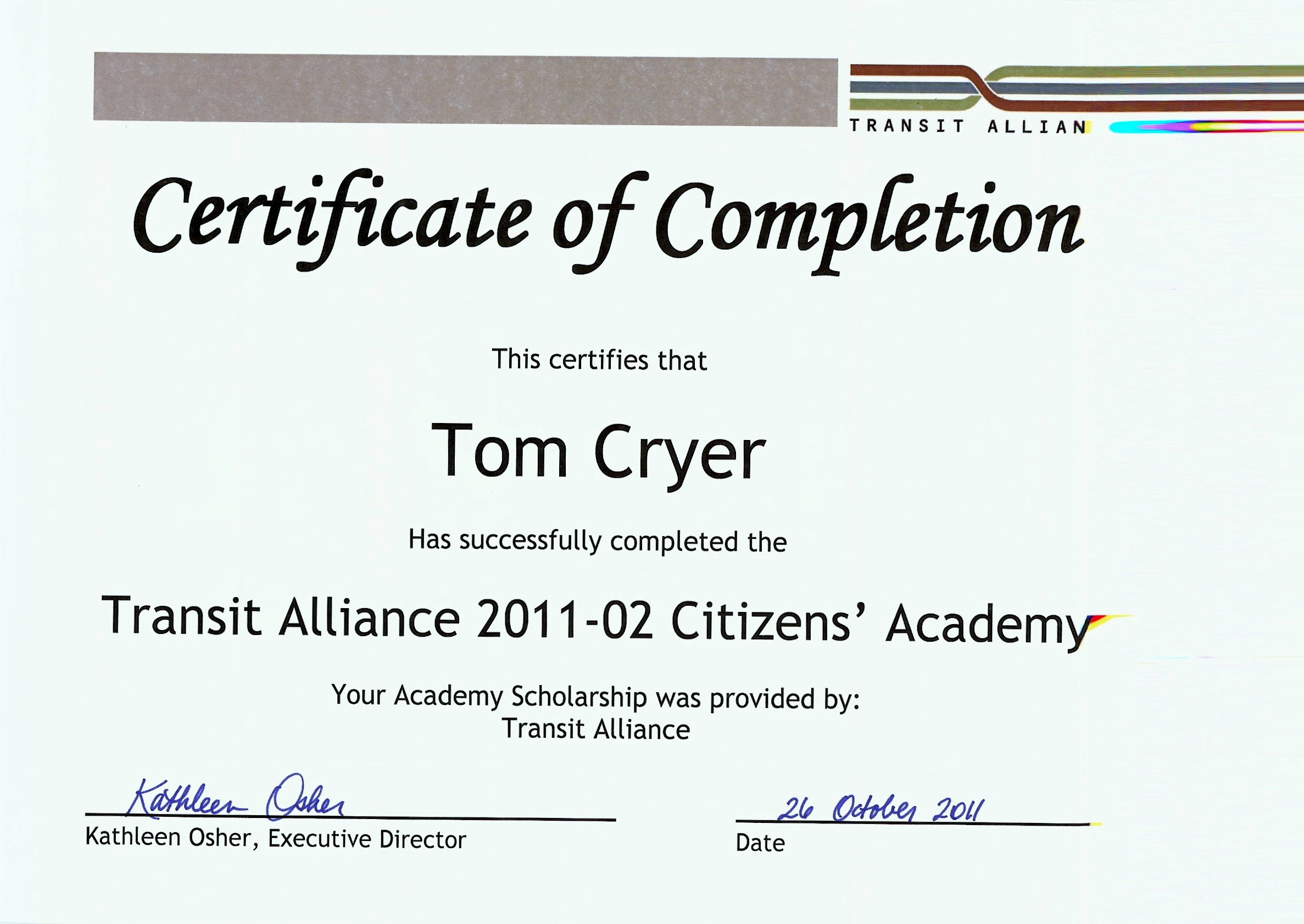
Certificate of Completion
Being severely ADHD in a classroom environment, I had a concern whether I could. Talking Heads, Videos, Discussion Groups, Planning Sessions and Tours, were fodder for a hysterical reaction and a flight for the door. But, this was not the case. TACA was so foreign, so different, so tactically removed from my daily routine, I soon settled in as a committed Student of Transit.
Let me come clean, I have always believed that public transportation systems were onerous Ponzi Schemes cursed on their tax payers without regard for real economic sense. In short, I was not drinking the Kool-Aid in any way shape or form. I went into that classroom as a Transit Anarchist convinced I would be able to hold my ground, and then walk away from the Academy with my beliefs intact.
Week #1 began as something of an introductory, welcome, hello, hello, handshake, but then without notice we were right into it. Housekeeping, mandatory attendance, ground rules, Action Plan, and a report from RTD’s own Pauletta Tonillas the RTD Public Information Officer. With each week, we ended with a debriefing and a written evaluation. I learned quickly, this was not a hobby; this was a real academy of learning, exchange and self-realization.
RTD provided several fact sheets, system information and future plans, and I have included this handout here.
Additionally, Ten Toe Express 2011 was introduced to us, and I have also included the hand out here.
Needless to say, my head was swimming on the drive home. In seven weeks, would I be experiencing guilt for having an auto-centric suburban lifestyle? Over the next seven days, my reticular activators were already focused. I saw buses, light rail and the shuttle in a brighter light already. Was the Kool-Aid working?
Week #2 began with a link to Week #1, some introductions, some information, but before I could pull myself away from my email and pay attention, we were engrossed in a presentation by Brad Calvert from the Denver Regional Council of Governments focusing on The Denver Region’s Plan for Growth and subsequently MetroQuest Café’ Scenario Planning. Our minds would not sit idle in this classroom. We were included, we were a part of the activity and we were made to visualize the planning process. This transit thing is not an easy one. It is a very complex business of Money, Planning and Results. Without results, the plan ultimately has no future. Without a plan, transit has no future.
DRCOG’s Who is TOD in Metro Denver and The Café’ Conversation presentations are provided for your review here.
Once again, on my drive home, my thoughts raced. My conversations with fellow Academy Fellows returned and rethought as I raced along. I looked over as I drove south on I-25, Light Rail was heading north. Was it all starting to make sense, or was it fatique?
Week #3 was on me before I knew it. The Academy is giving me a new respect for all the students around the world taking night classes for years, not just 7 weeks. This week’s presentations lead off with Crissy Fanganello from the City and County of Denver, The topic, Re-shaping the Denver Metro Region.
It took me awhile, but after the screening of “Denver Union Station – A Portal to Progress” was finished, I was catching on. You should watch it too. The Kool-Aid will taste better along the way.
“In 1881 the largest building West of the Mississippi opened on the soggy edge of a tenacious frontier town. For over eighty years, Denver Union Station bore witness to a procession of arrivals and departures that transformed the Rocky Mountain West. From 19th century regional gateway to 21st century multi-model hub, “Denver Union Station: Portal to Progress” tells the story of the grand era of railroad travel and the awe inspiring structure that stands today at the crossroads of past glory and future promise.”
<p><a href=”http://vimeo.com/7596441″>Denver Union Station: Portal to Progress – USA Trailer</a> from <a href=”http://vimeo.com/haveypro”>Havey Productions</a> on <a href=”http://vimeo.com”>Vimeo</a>.</p>Week #4, Holly Cow, a Field Trip; we didn’t even meet at Metro Denver’s Classroom, we met outside at Union Station, but wait, a quick orientation inside and then a walking tour of the transition taking place to this historic ground surrounding it.
Here are a couple of images from the tour.
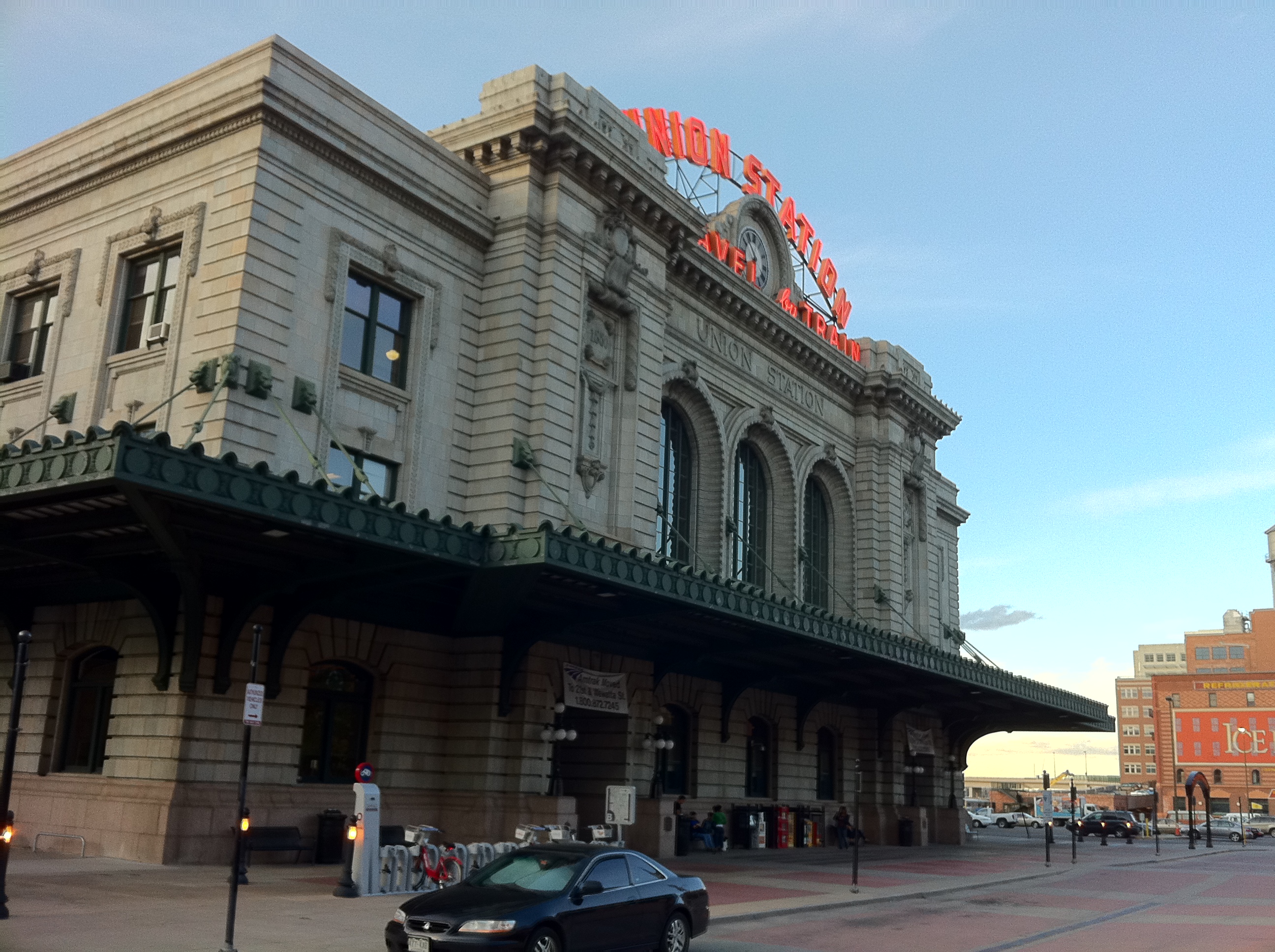
Union Station Front
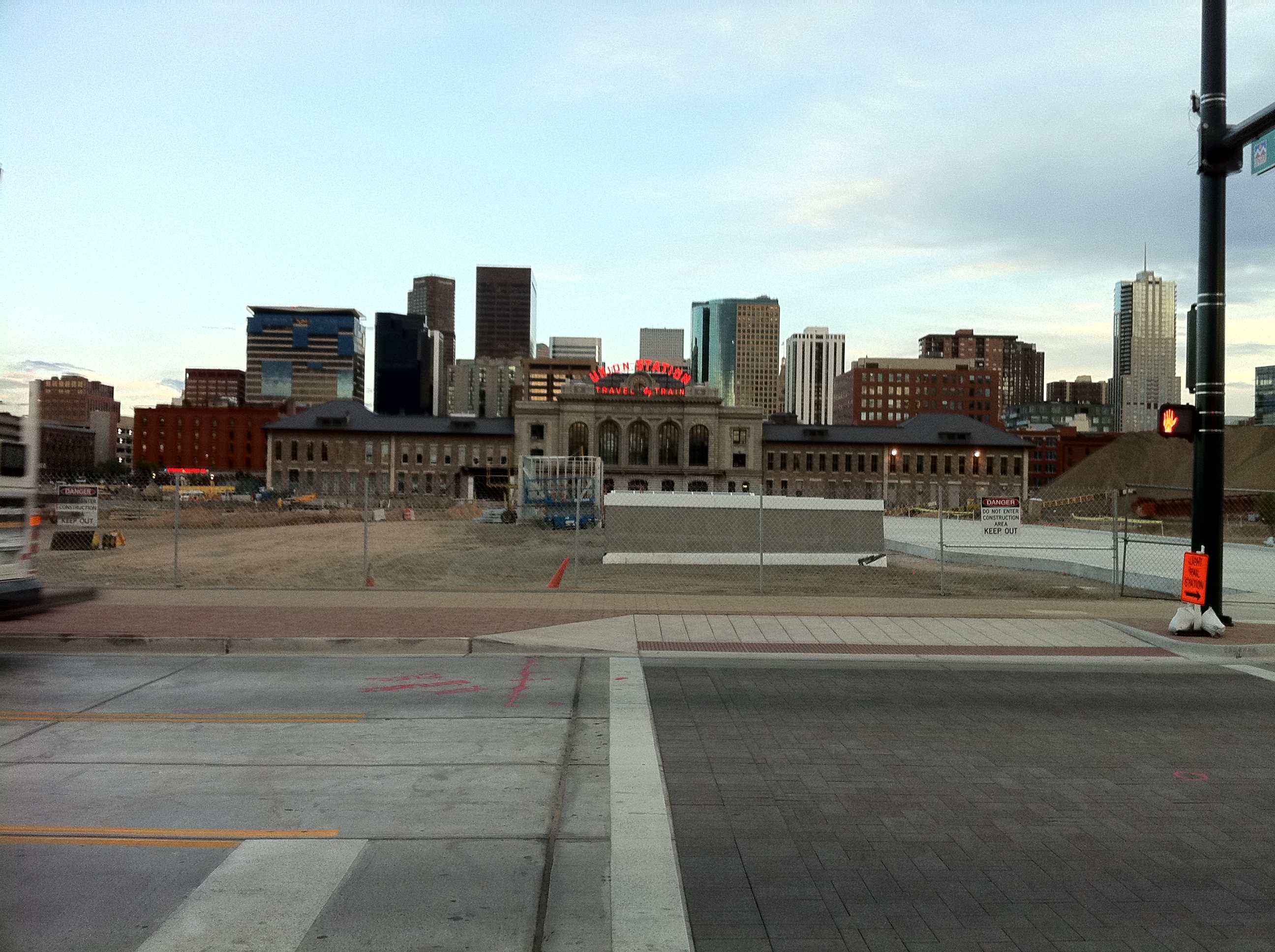
Union Station Now
Here is a comprehensive look at the future of Denver’s Regional Transportation Plan.
A leisurely walk back to Metro Denver’s Classroom for the piece of the transit puzzle I had never considered. The health characteristics of public transit riders, pedestrians and bicyclists is definitive, but what I didn’t know is what Dr. Sandra Stenmark, a Pediatrician and the Director of Wellness and Cardiovascular Risk Reduction Program for Kaiser Permanente was about to show us.
Ms. Stenmark’s presentation was focused, to the point and demonstrative. Her clear and pragmatic display of the statistical, the anecdotal and the personal was clear to all of us. Public transportation can have a huge impact on our health, but also on the health of less economically fortunate. We learned transit is part of a bigger model I had never considered before that moment. For the most part, my Academy Fellows had the same feelings when our evening was finished.
Once again, I had a lot to digest on the way home and the week to follow. I’m visualizing transit considerations, opportunities and communities more freely. I can honestly say, “I am enjoying the academy!”
To this point, you’re thinking, force fed knowledge. Sponging in the backrow, taking it all in, growth from osmosis, but nothing could be further from the truth. The realization in the back of our collective heads is becoming front and center. We have an Action Plan and an Academy Presentation to complete before we have successfully completed the program. The wheels are really spinning at this point. What to do next?
Week #5 arrives with our classroom organized into work group settings. Tables and chairs set up to accommodate group activity. Our collective knowledge of Transit Oriented Communities will be put to work.
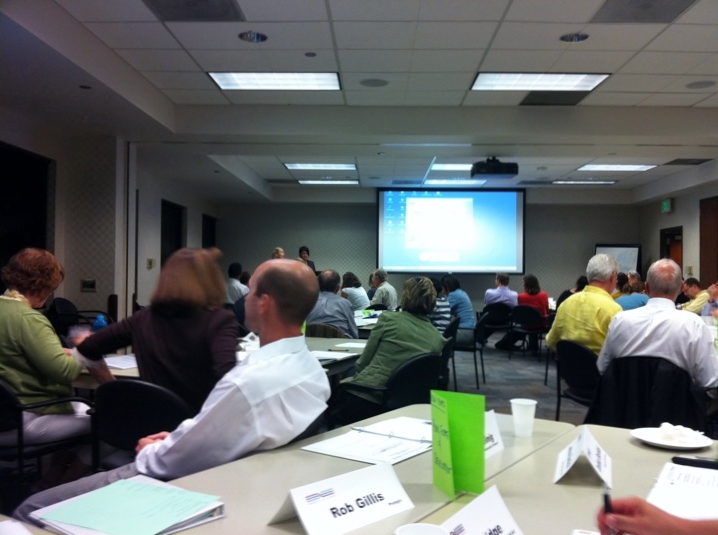
Classroom Time
Jacob Riger & Patrick Picard, Transit Planners, from Charlier Associates, Inc. will preside over this week’s session. Our visualization skills will be optimized by the help of before and after photography, classroom discussion and a case study of El Paso, Texas. Can you believe it? As if Denver doesn’t have enough problems, we were literally seeing the before, then we were executing our group plans, and then we were seeing the after from Jacob and Patrick. The interaction at our group tables, the discussions and the results were impressive for rookies, but then Jacob displayed the reality of transit development by demonstrating the reality of a limited budget, access to real estate and community involvement.
The evening is over, and one thing is certain; this transit thing is complicated!
Week #6 has an air of excitement associated with it for me. First, Tom Clark, Executive VP, Denver Metro Economic Development Corporation, Denver Metro Chamber of Commerce is going to discuss Keeping the Denver Region Competitive. I’ve heard Tom speak many times over the years, and I always enjoy his pragmatic style of pull no punches. By the time Tom wraps up, we have been entertained, informed and left with a plate full of food for thought. Gracious as a man can be, Tom actually thanks us for taking the time and effort to attend the Academy, and impresses upon us the value of our new found knowledge on Denver’s future.
But wait, there’s more! The second half of the evening was the start of our presentations to our fellows at the academy. I’m up third. At this point, I am truly interested in the other ideas before me and the ones to come after. I’ve attached my Action Plan and Presentation here.
I’m past my presentation time window, questions and suggestions are still coming in, and a couple of people offer little scraps of paper with urls scribbled down for my reference. A team spirit has clearly evolved in just a few short weeks. The Kool-Aid really tastes great right about now. As a group, we are starting to pull together. A sense of camaraderie is clear. The Academy is working.
On my drive home, I’m rendered to constant observation along I-25 as I wonder about my next steps in executing my Action Plan. I am starting to understand the what’s and why’s of our transit system. For me, it’s no longer just a map on a piece of paper. It has a life of its own. It will reach out like the tentacles of an octopus into the communities that surround it. Only this time, they will be helpful reaches assisting residents of all ages, abilities and needs. I truly understand the vision, the future of Denver, the need to stay competitive in a global market place.
Week #7 is entirely devoted to the remaining Action Plan Presentations. The presentations are as diverse as our fellows. From Bike Lanes & Bike Sharing to Special Needs Drop Off and Pick Up, there has been no want or need left out by the time the last presentation closes. My interest and understanding has grown from seedling to small tree. My only hope is one day, it will be a mighty oak!
I would be remiss if I didn’t spend at least a minute telling you about Kathleen Osher our Executive Director and Cady Dawson our Assistant Director. Without their tenacity, hard work and passion for the Academy, it wouldn’t happen. They are the true “White Hats” behind the scenes. They make sure the technology, the classroom, the Food & Drink, the participants and presenters are well cared for and engaged. I know they are proud of what’s been accomplished at the Academy; I know I am proud to have been just a small part of their determination. Thank You Kathleen and Thank You Cady, and may you have many more successful Academies like this one!
And finally, the answer to the omnipresent question is; A transit oriented community is socially responsible. No more jokes about Kool-Aid, I promise!
 Here are the 16 top Holiday Events for 2011 up and down the Front Range. From Colorado Springs to Longmont, let’s get out and enjoy the festivities!
 Breakfast with Santa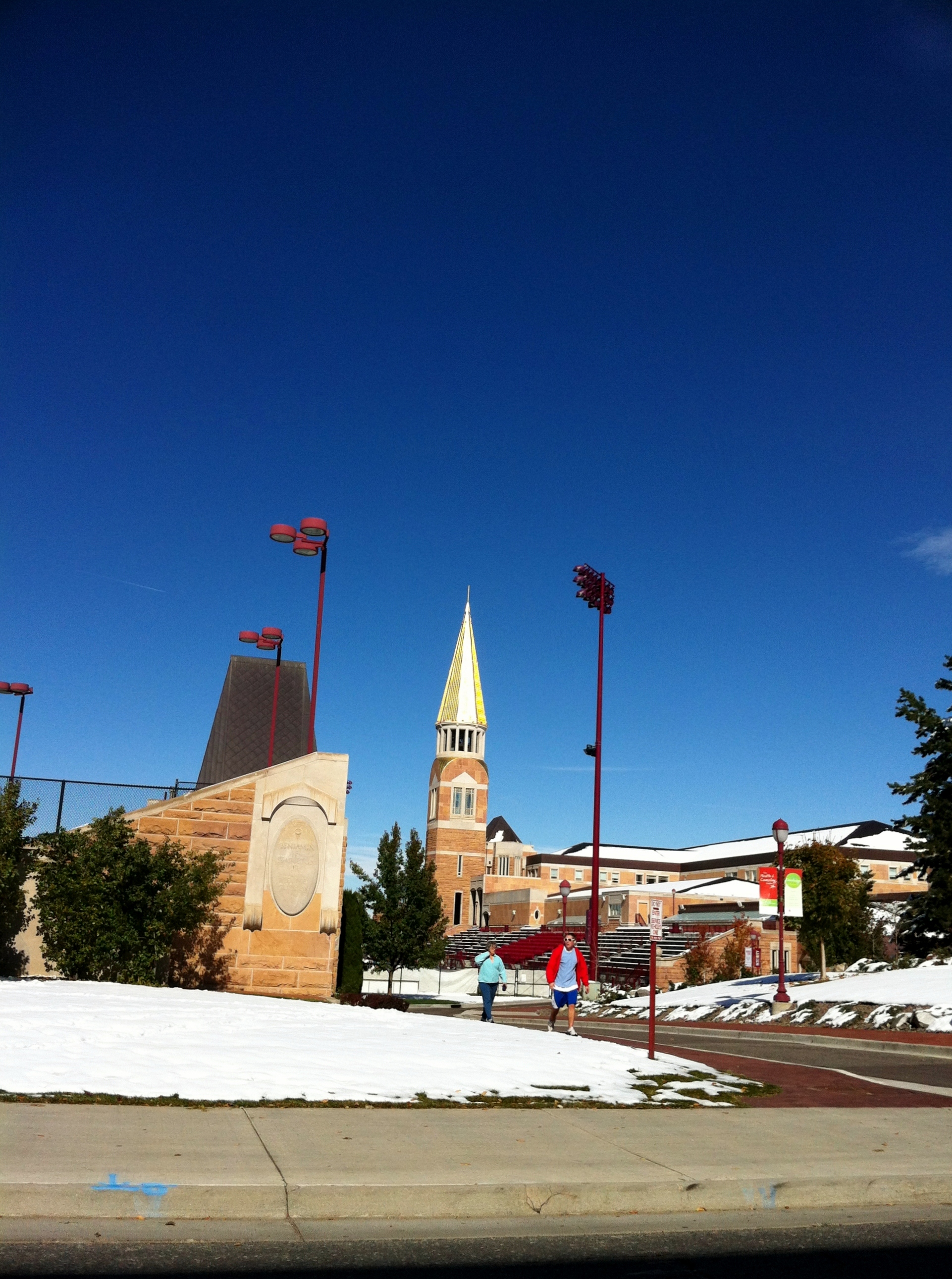
Williams Tower View from Asbury
Last week, I had the pleasure, paranoia and exuberance assocated with a midday carillon performance high above the University of Denver‘s campus. Ninety-Five steps up the winding tower staircase that already starts on the 4th floor puts you on top of the world. Metallic clicks with each foot-drop up the staircase add to the suspense of what’s on top.
I can tell you straight up, if you have any trepidation with heights, force yourself past the staircase. Soon, you will be shrouded at the top and into the concert room. Before you, the carillon keyboard resides with 360º views and sounds of delight. It will be worth overcoming your paranoia of heights. The experience is something you can’t describe other than, “You have to be there”.
At 215 feet, the Ritchie Center’s gold-capped Williams Tower is visible from more than a mile away. Clearly a beacon for a campus that’s a hub of activity for the entire community.
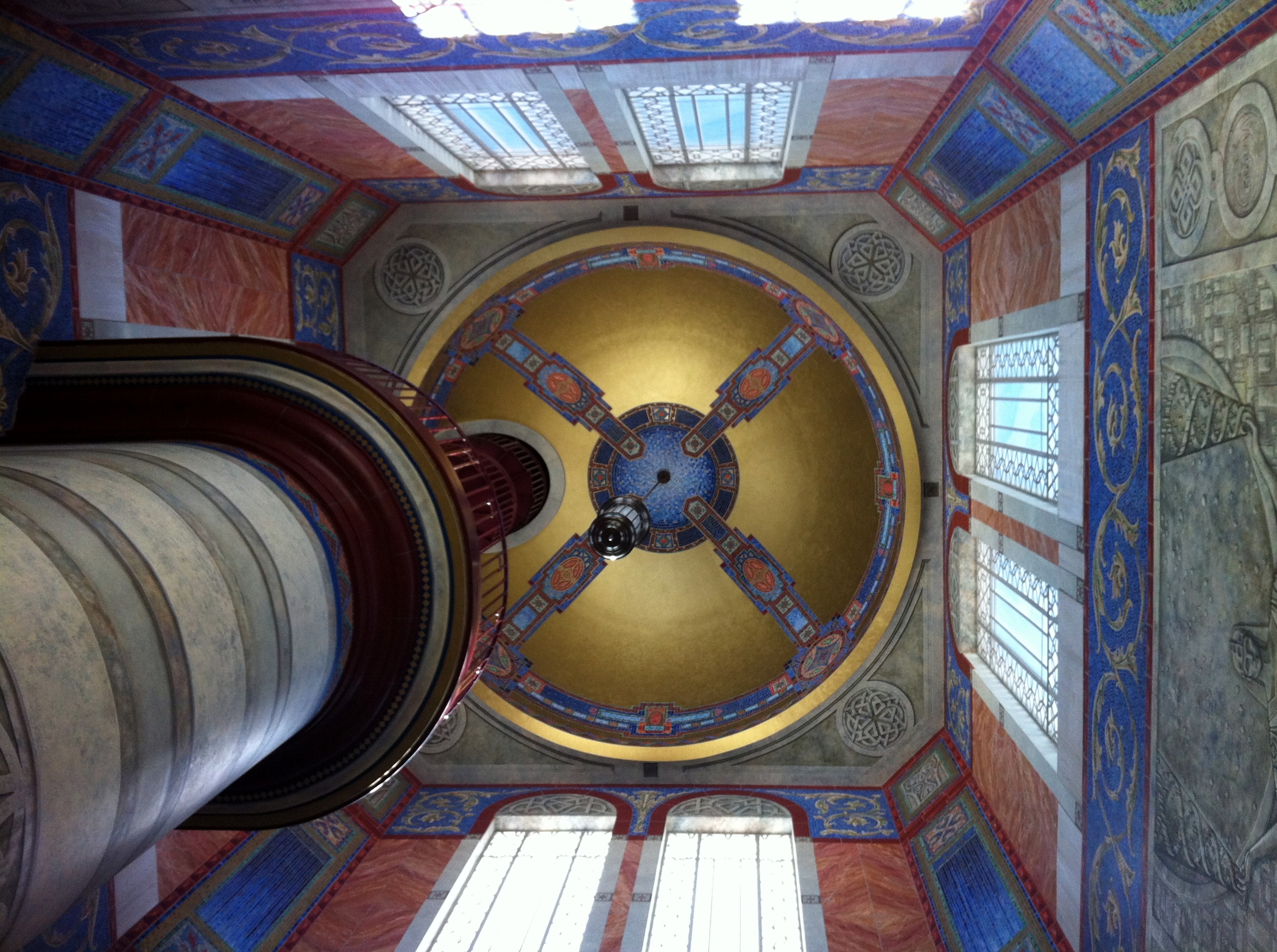
William's Tower Interior View
On this particular day, Carolyn Bolden was my escort, tour guide and my carillonneur. We met on the Ritchie Center steps just below the Williams Tower. We hopped on the elevator to the 4th floor, walked past the athletic offices through the Gottesfeld Room and at once one is taken aback by the tower room. A vertical history of communication as we know it. But that’s another story!
Up the tower steps to the top. I have to admit, this could be intimidating to the uninitiated. The tower housesthe Williams Carillon,
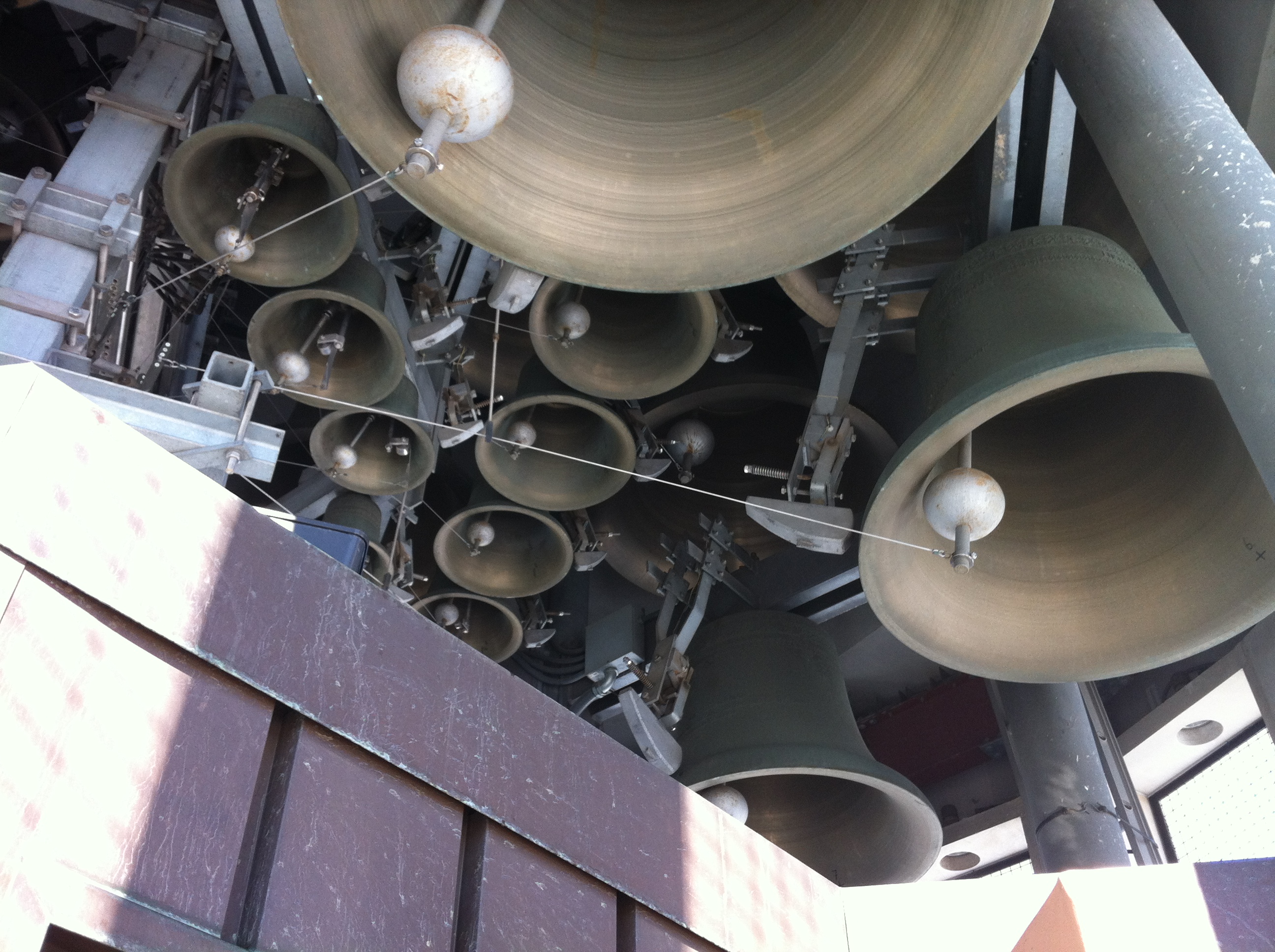
Carillon Bells
a set of 65 chromatically tuned bronze bells, the largest of which weighs about six tons. The carillon chimes on the hour, helping students across campus keep track of the day. Every December, the University carillonneur treats the campus community to a holiday concert.
One this particular day, I was going to get a 15 minute private concert of my own from Carolyn. She has such enthusiasm for the instrument, such a burning desire to master it and such a generosity of spirit, I was immediately caught up in the moment. The view, the location, the bells, the music, I can’t impress upon you how much fun this was, but also mesmerizing at the same time. The music is almost hypnotic. It is saying, “take a moment and listen”. Not unlike take time to “smell the roses”, in this instance, it offers a rhythmic reprieve from the day’s activities.
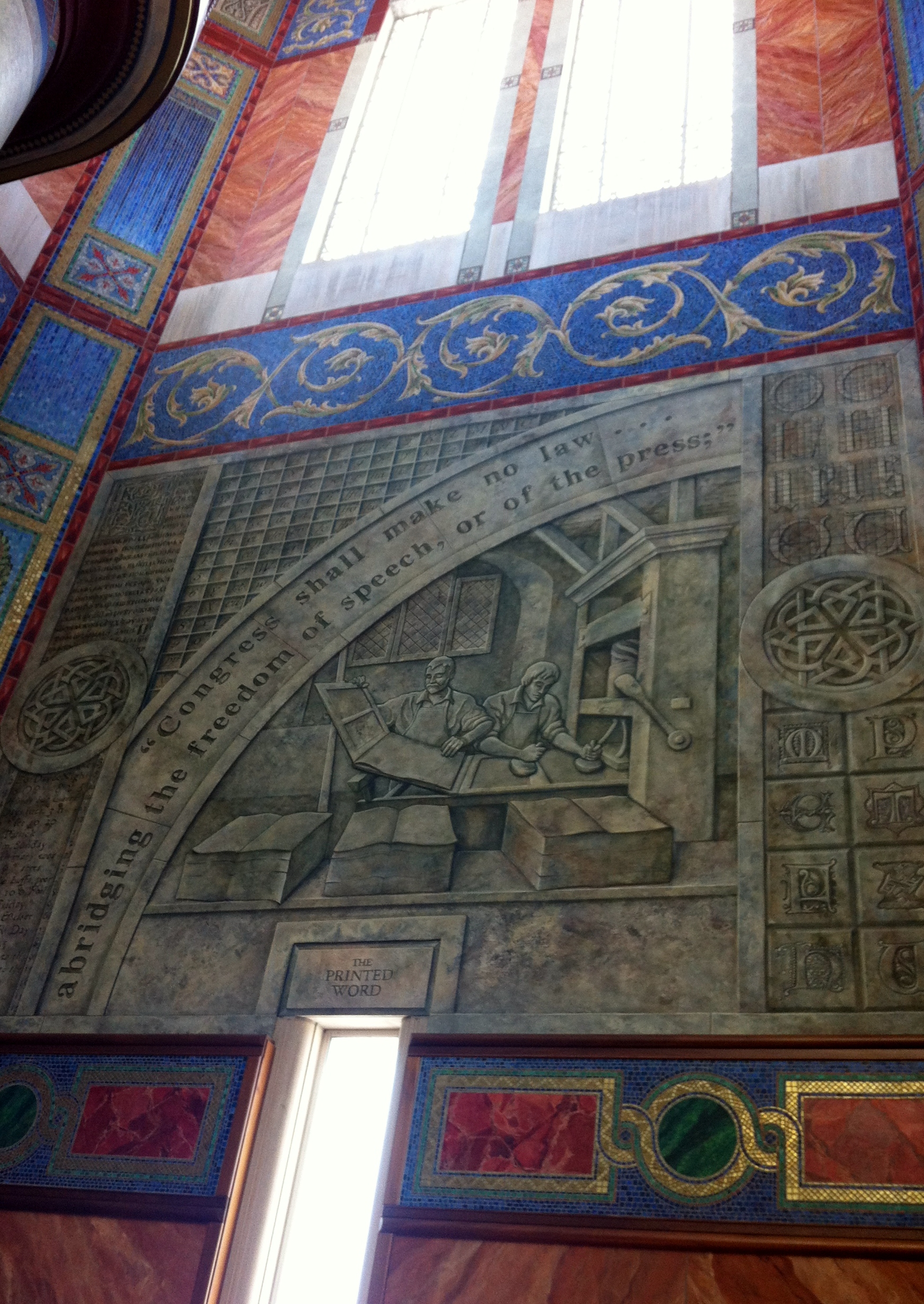
The History of Communication and Free Speech
Watching a Carilloneur, hearing the sounds, seeing the sites and taking time out from a busy day. This is living life as it was meant to be lived. Thank You Carolyn!
September, 2011 Issue 39
 144 Colorado Companies on Inc. 5000: Inc. magazine included 144 Colorado companies on its annual Inc. 5000 of the fastest-growing private companies in America, including 14 that made the Inc. 500 list. read more here
Denver Residential Real Estate Sales Top $1B in July: For the second month, the amount of residential real estate sold in metro Denver topped $1 billion in sales volume. read more here
Denver 20th in U.S. for New Home Projects: Metro Denver ranked 20th in the nation for new housing construction projects authorized in 2010 out of 366 metro areas, according to a new analysis of U.S. Census Bureau data. read more here
Colorado Foreclosure Filings Decline: Foreclosure filings in Colorado continued to decline in the second quarter, dropping almost 30 percent from the same months of 2010, according to a state report August 11th.
read more here
Pro Cycling Challenge Give Colorado Economy a Boost: Because of the U.S. Pro Cycling Challenge, the weekend of August 27th all hotels in Denver were booked. And that’s just one benefit of the week-long event that will have a huge economic impact on Colorado. read more here
HUD: Colorado Leads Region in Job Gains: Economic conditions in the Rocky Mountain region have improved in recent months, with the largest recent payroll increases reported in Colorado and North Dakota, according to economists from the U.S. Department of Housing and Urban Development.
read more here
12 Colorado Schools on Forbes Best-Colleges List: Forbes magazine’s annual ranking of America’s top undergraduate schools puts the United States Air Force Academy in the top 10. Also on the list from Colorado: Colorado College in Colorado Springs; Colorado School of Mines, Golden; University of Denver; University of Colorado, Boulder and more. read more here
Denver Hotels Lead Nation in Two Key Areas: Hotels in Denver had the highest jump in the average daily rate among the country’s 25 largest metro areas, according to a new report by STR Global, a Hendersonville, Tenn., hotel research company. read more here
Forbes Rates 2 Colorado Cities ‘Best Small Places for Business’: Grand Junction ranks in 12th place in a new Forbes ranking of the nation’s “best small places for business and careers.” And Pueblo ranks No. 37 on the Forbes list out of 184 smaller cities and towns. read more here
 Louisville Named Best Small Town by Money Magazine: A Colorado town has topped Money Magazine’s “Best Place to Live” list once again. For towns with populations ranging from 8,500 to 50,000, Louisville has been crowned number one. read more here

Super Joe Hubert
Hi Tom,
Listed below are Real Estate Market Update links for September, 2011 and a PDF attachment of likely MLS areas for DTC sales offices.
The September sales information had a few positive and not so positive signals. September, 2011 combined MLS Residential Statistics had the following changes compared to September of 2010.
For more details on the combined MLS Residential Statistics, select the first link below titled “Total MLS” or feel free to contact me if you have any questions.
Total MLS
All Metrolist Areas as one download
Aurora North (AUN)
Aurora South (AUS)
Brighton, Fort Lupton (BFL)
Broomfield (BRM)
Douglas County West (DCW)
Douglas Elbert Parker (DEP)
Douglas Highlands Ranch Lone Tree (DHL)
Denver Northeast (DNE)
Denver Northwest (DNW)
Denver Southeast (DSE)
Denver Southwest (DSW)
Downtown Denver (DTD)
East Suburban North (ESN)
East Suburban South (ESS)
Jefferson County Central (JFC)
Jefferson County North (JFN)
Jefferson County South (JFS)
Jefferson County West (JFW)
Jefferson County Northcentral (JNC)
Jefferson County Southcentral (JSC)
Lafayette (LAF)
Mountain Clear Creek (MCC)
Mountain Conifer Pine (MCP)
Mountain Evergreen North (MEN)
Mountain Evergreen South (MES)
Mountain Gilpin County (MGC)
Mountain Jefferson County (MJC)
Mountain Jefferson North (MJN)
Mountain Jefferson South (MJS)
Mountain Park County (MPC)
Mountain Park East (MPE)
North Northeast Suburban (NNE)
North Northwest Suburban (NNW)
North Suburban Central (NSC)
North Suburban East (NSE)
North Suburban West (NSW)
South Suburban Central (SSC)
South Suburban East (SSE)
Superior (SUP)
Joe Hubert
Land Title Guarantee Company | 5690 DTC Blvd. #650E | Englewood | CO | 80111
Add jhubert@ltgc.com to your safe senders list. Click here for directions
To unsubscribe Click Here
 Fall is for:


 MyTownCryer
You must be logged in to post a comment.